


Trichiasis correction surgery is performed to treat inward-growing eyelashes that rub against the ocular surface. Trichiasis can cause eye irritation, tearing, and even corneal injury. The procedure corrects the abnormal lash direction—or removes the misdirected eyelashes—to restore comfort and protect the health of the eye.


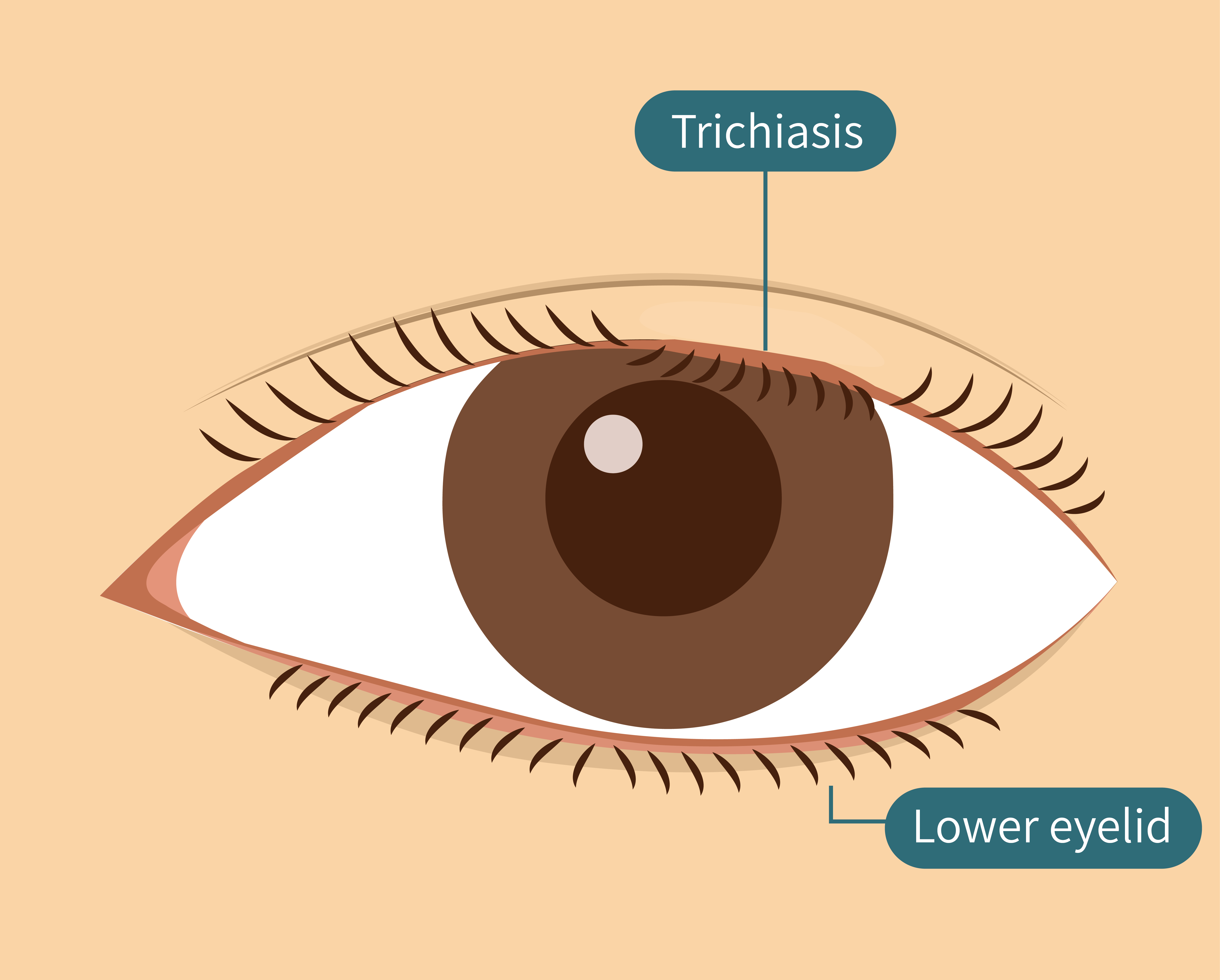
Trichiasis refers to a condition in which one or more eyelashes grow in an abnormal direction,
turning inward and touching the surface of the eye—including the transparent cornea or the
conjunctiva of the sclera. This constant friction can cause persistent eye pain, redness,
tearing, light sensitivity, and a pronounced foreign-body sensation, leading patients to blink
frequently or rub their eyes. Vision may also become blurred.
If left untreated, prolonged
irritation may scratch the cornea and lead to corneal damage, infection, or even scarring. In
severe cases, it may result in corneal perforation and permanent vision loss. Repeated eye
rubbing over time may also worsen astigmatism, affect visual development in children, and
potentially lead to amblyopia. If you experience any of these symptoms, it is recommended to
seek evaluation from an ophthalmologist as soon as possible to receive timely treatment.
The causes of trichiasis are complex and can be broadly categorized into congenital and acquired types:
With age, the eyelid skin and supporting structures—such as connective tissue and ligaments—gradually loosen and degenerate. This may lead to entropion (inward turning of the eyelid), which can cause an entire row of eyelashes to rub against the eye, often resulting in more severe symptoms.
Chronic conjunctivitis, trachoma, or blepharitis may cause inflammation and fibrosis around the eyelash follicles, altering the normal direction of eyelash growth.
Injuries to the eyelid or previous ocular surgeries may cause scar contracture, pulling the eyelid and leading to abnormal eyelash growth.
Long-term or recurrent eyelid spasms may exert abnormal pressure on the eyelash follicles, causing changes in growth direction.
There are various treatment options for trichiasis, ranging from conservative management and non-invasive procedures to surgical correction. The choice of treatment depends on the number of misdirected eyelashes, the underlying cause, as well as the patient's age and overall condition.
For children with epiblepharon, if corneal involvement is mild and does not affect visual development, a conservative observational approach may be taken, as the condition often improves naturally with facial bone growth.
Some parents may take their children for eyelash perming to curl the lashes upward and reduce corneal irritation.
Manually removing the misdirected eyelashes can temporarily relieve symptoms. The lashes typically grow back within 4 to 6 weeks, requiring periodic clinic visits for repeat epilation. Note that some fine, barely visible lashes can only be detected and removed under a microscope, requiring assistance from an eye specialist. Due to pain and the need for cooperation, this method is generally not suitable for young children under local anesthesia.
These treatments destroy the eyelash follicles—either through electrical cauterization or extreme cooling—so that the misdirected lashes do not grow back.
Electrolysis is suitable when only a small number of misdirected eyelashes are present and clustered in a localized area. For cases involving a larger number of abnormal lashes, cryotherapy may be considered as a more effective option.
Multiple sessions may be required to achieve a permanent result. Temporary eyelid swelling or scabbing may occur after the treatment. Due to pain and the need for patient cooperation, these procedures are generally not suitable for children under local anesthesia. Cryotherapy may also cause postoperative skin depigmentation (whitening) of the eyelid.
Surgery is the most effective and typically the most long-lasting treatment for trichiasis. Because the anatomical structure and functional characteristics of the upper and lower eyelids differ, the surgical considerations and techniques also vary accordingly.
Correction of upper-lid trichiasis—especially when the affected area is extensive or when cosmetic enhancement is also desired—is often performed in combination with double eyelid surgery.
During double eyelid surgery, the surgeon precisely adjusts the tissues in front of the levator muscle or tarsal plate. By creating a double eyelid crease, the eyelashes are naturally rotated upward, preventing them from touching the ocular surface. For cases involving upper-lid epiblepharon, double eyelid surgery is required, and medial epicanthoplasty may be considered depending on the patient's anatomy to achieve the best treatment outcome.
Achieving high symmetry in both the upward rotation of the eyelashes and the width of the double eyelid crease is particularly challenging. The elasticity and tension of the eyelid skin influence crease formation; even a slight difference in skin tension between the two sides may result in one crease appearing wider or narrower. Precise control of this tension relies heavily on the surgeon's experience and judgment.
The design and execution must be meticulously calibrated to prevent excessive eyelid tightening. Overcorrection may not only result in an unnatural double eyelid appearance but may also cause eyelid eversion, compromising both aesthetics and eyelid function.
Successful correction of upper-lid trichiasis, especially when combined with double eyelid surgery, requires detailed planning and refined technique to achieve both functional improvement and aesthetic enhancement.
Treatment options for lower-lid trichiasis range from non-invasive approaches to surgical correction, depending on the number of misdirected eyelashes, underlying causes, and patient-specific factors.
If lower-lid trichiasis is caused by entropion, the surgical procedure focuses on correcting the inward turning of the eyelid. Techniques may include tightening the eyelid tissues with sutures, excising excess skin or muscle, or reinforcing the tarsal plate to restore proper eyelid position and rotate the eyelashes outward.
Depending on the specific condition, structural reconstruction or adjustment of the eyelid may be performed to address the root cause of trichiasis. For example, in pediatric epiblepharon, surgery is typically performed under general anesthesia. Excess skin and hypertrophied orbicularis muscle beneath the lash line are excised, followed by precise wound closure. In cases involving aberrant or misdirected hair follicles, follicle excision may be required.

Patients with numerous misdirected eyelashes, patients with a wide distribution of inward-growing lashes, and individuals with underlying eyelid structural abnormalities, such as lower-lid entropion or pediatric epiblepharon.
Surgical correction typically offers long-lasting results and effectively resolves the underlying cause of trichiasis.
During lower-lid correction, meticulous technique is essential. If too much orbicularis oculi muscle
is inadvertently removed, the immediate trichiasis issue may be resolved, but irreversible cosmetic
consequences may occur. The aegyo-sal—the natural lower-lid fat roll—may disappear, altering the
patient's eye shape. In more severe cases, scleral show (excessive exposure of the white part of the
eye below the iris) may occur, affecting both aesthetics and eyelid function. Thus, achieving
outward lash rotation without altering the patient's natural eye shape, while preserving the
lower-lid contour and aegyo-sal, requires precise preoperative planning and substantial clinical
experience.
It is important to consult an experienced ophthalmologist for eyelid procedures.
We strive to treat your condition while preserving the natural beauty and function of your eyes.
One Week Before Surgery:
・Discontinue anticoagulant medications (such as aspirin). Please confirm with your
prescribing physician whether temporary discontinuation is appropriate.
・Stop taking all nutritional supplements (such as fish oil, ginkgo, ginseng, and vitamin
E).
・Avoid smoking and alcohol from one week before surgery until one month after the procedure.
On the Day of Surgery:
・Please arrive with a clean face and no makeup; remove any eyelash extensions.
・Do not wear any accessories or metal items. If you have piercings, please remove them in
advance.
・If you are nearsighted, you may wear contact lenses to the clinic, but they must be removed
before surgery. Please bring a storage case, eyeglasses, or sunglasses for use afterward.
・Local anesthesia does not require fasting, and you may eat and drink as usual.
・General anesthesia requires fasting for approximately 8 hours. Please avoid all food and
drinks, including water and chewing gum.
・Please do not drive or ride a motorcycle yourself after the procedure.
・Cold and Warm Compresses: Apply cold compresses
during the first 72 hours after surgery to help reduce swelling and bruising. Warm
compresses may be started after 72 hours to promote circulation and healing.
・Wound Care and Dressing Changes: Keep the incision
area clean and dry after returning home, and change dressings as instructed. If skin sutures
are present, they are typically removed around 6–10 days postoperatively, depending on wound
condition.
・How to Change Dressings: Clean the wound twice
daily using sterile cotton swabs dipped in normal saline, dry the area, and then apply the
prescribed ointment. When performing cold or warm compresses, place a piece of gauze over
the wound to reduce the risk of infection.
・Medication and Eye Hygiene: Use the prescribed eye
drops or ointment as directed to prevent infection and support healing.
・Eye Use and Daily Habits: Avoid prolonged use of
mobile phones, computers, or looking down for extended periods. Allow your eyes sufficient
rest to facilitate recovery.
・Diet and Medications:
- You may take the prescribed pain relievers as needed to ease postoperative discomfort.
- Avoid irritants such as smoking, alcohol, tea, coffee, spicy foods, and dietary
supplements (including vitamin E, lingzhi, and traditional herbal medicine).
- A light diet is recommended, along with adequate hydration and increased intake of protein
and vitamin C to support wound healing.
TEL 02-2700-8069
Add Our Official LINE

2F, No. 263, Sec. 1, Dunhua S. Road,Da'an District, Taipei City 106, Taiwan
Our clinic operates by appointment only.