


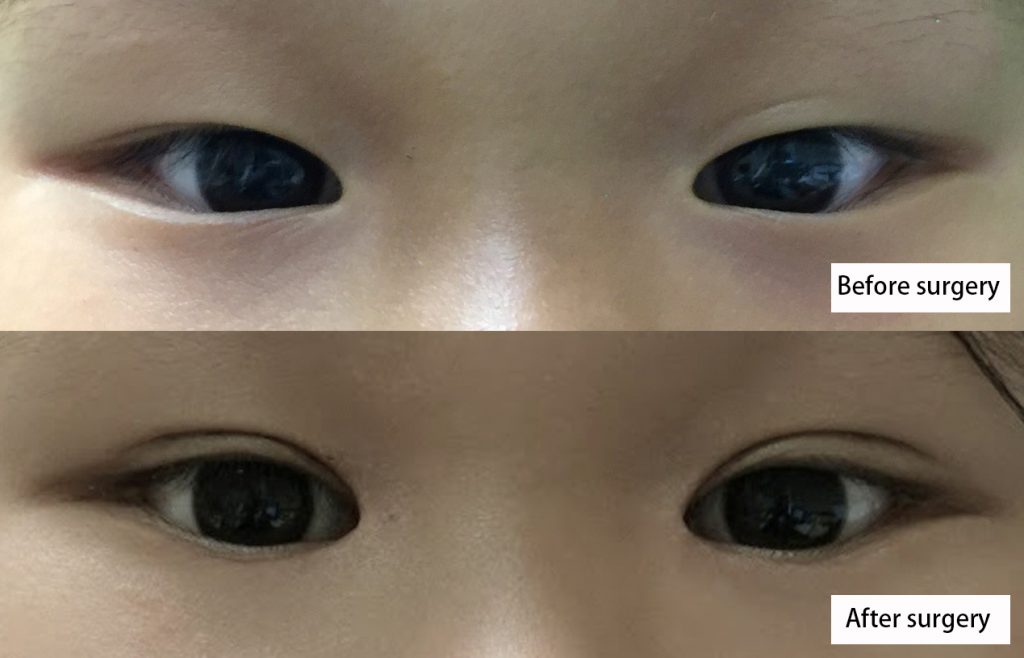
Medial Epicanthoplasty
2026.09.04
Many parents worry that their children have “crossed eyes.” However, clinical evaluation often reveals this to be the common Epicanthal Fold (commonly known as the “Mongolian fold”) seen in Asian children. This is a benign, physiological appearance that naturally improves as the nasal bridge develops and the face matures, typically requiring no medical intervention. Only true esotropia warrants professional evaluation and guidance; parents need not be overly anxious.
What is an Epicanthal Fold? Why Does it Cause “Pseudoesotropia”? The Epicanthal Fold is a natural feature of early facial development in Asian children. This skin fold, located at the inner corner of the eye (near the nasal bridge), partially obscures the medial sclera (the white of the eye).
Does the Epicanthal Fold Change Over Time? When is Adjustment Needed? In the vast majority of cases, epicanthal folds undergo favorable physiological changes as the child matures:
Home Observation: How to Differentiate True “Esotropia” True esotropia stems from an imbalance in extraocular muscle dynamics, leading to persistent ocular deviation. If left untreated during the critical window of visual development, it may affect stereopsis (depth perception) and lead to Amblyopia (lazy eye). Parents can perform a preliminary check:
FAQ: Common Questions Regarding Child Ocular Alignment
Q1: Is “cross-eyedness” caused by a flat nasal bridge? Yes. In young children, the nasal bone is not yet fully developed, and the skin at the inner eye corner is relatively loose. You can gently pull the skin on both sides of the nose toward the center; if the medial sclera is exposed and the “cross-eyed” appearance vanishes, this confirms that the appearance is a benign visual illusion.
Q2: If the child has true esotropia, is surgery always necessary? Not necessarily. If it is Accommodative Esotropia caused by high hyperopia (farsightedness), prescription glasses can correct the alignment. Surgery is typically reserved for cases with a large angle of deviation or non-accommodative congenital esotropia.
Q3: Will playing with toys cause a child to become cross-eyed? No. The convergence of pupils when focusing on near objects is a normal muscle function and a healthy exercise. It does not cause permanent strabismus. However, keeping toys at a distance of at least 30 cm is recommended.
Q4: At what age should epicanthoplasty be performed? We strongly advise against surgery for purely aesthetic reasons during early childhood. Surgery is only recommended earlier if severe trichiasis is causing corneal damage.
Q5: What if my child is too young to cooperate with the examination? Ophthalmologists use colorful, dynamic toys to perform “instant focus” checks in a playful environment. It is best to visit the clinic when your child is well-rested and in a good mood.


TEL 02-2700-8069
Add Our Official LINE

2F, No. 263, Sec. 1, Dunhua S. Road,Da'an District, Taipei City 106, Taiwan
Our clinic operates by appointment only.


