


Trichiasis Correction
2026.09.04
If you frequently experience an indescribable foreign body sensation, feel the urge to rub your eyes, or suffer from chronic epiphora (excessive tearing), it may not be simple eye fatigue, but rather symptoms caused by Trichiasis. If left untreated, trichiasis—where eyelashes continuously rub against the eyeball—can lead to corneal epithelial defects, severe astigmatism, corneal infections, or scarring, potentially compromising your vision.
In this article, our specialist breaks down the common causes in children and adults, and explains modern surgical approaches that balance functional correction with aesthetic eyelid contouring.
Trichiasis occurs when eyelashes are misdirected toward the eyeball due to eyelid structural issues. As the delicate lashes repeatedly abrade the ocular surface, patients often experience:
Professional Note: If trichiasis is severe and remains untreated, chronic irritation may lead to recurrent corneal epithelial defects. In severe cases, it can induce significant astigmatism, corneal infections, or corneal scarring, all of which pose a long-term threat to visual acuity.
In pediatric ophthalmology, the most frequent cause is Epiblepharon (whereas eyelid entropion is most common in adults).
Surgical intervention should be considered based on the severity of the condition. Clinical indicators for surgery include:
Modern trichiasis surgery focuses on both functional correction and natural eyelid contours.
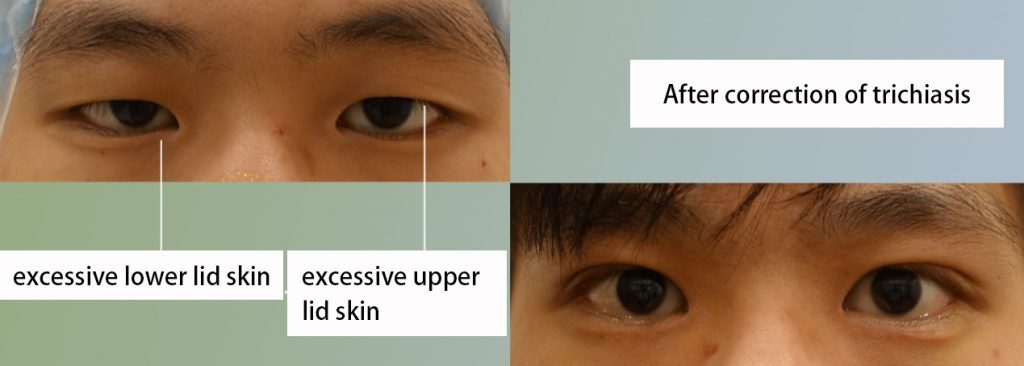
Q1: What are the most common causes of trichiasis in children versus adults? In children, it is most commonly due to Epiblepharon (skin and muscle hypertrophy). In adults, it is most commonly caused by Eyelid Entropion.
Q2: Does a child diagnosed with trichiasis require immediate surgery? Not necessarily. Many cases improve as facial features mature. If monitoring confirms no severe corneal damage or vision impairment, conservative observation is often preferred.
Q3: What are the consequences of leaving trichiasis untreated? Beyond discomfort, long-term irritation can lead to high astigmatism, corneal infections, and corneal scarring, all of which can cause permanent visual impairment.
Q4: Why shouldn’t surgeons remove as much muscle as possible? Precision is key. Removing too much Orbicularis Oculi Muscle risks “scleral show,” which negatively affects the aesthetic appearance of the eye.
Q5: How is upper eyelid trichiasis treated? Double Eyelid Surgery is often the preferred approach. The structural elevation naturally everts the upper lashes, correcting the trichiasis while optimizing eyelid shape.


TEL 02-2700-8069
Add Our Official LINE

2F, No. 263, Sec. 1, Dunhua S. Road,Da'an District, Taipei City 106, Taiwan
Our clinic operates by appointment only.


